IT Campus Logo

DevOps Roadmap 2026: A Complete Guide to Becoming a DevOps Engineer

DevOps Road Map 2026

DevOps Roadmap 2026: A Complete Guide to Becoming a DevOps Engineer

The demand for DevOps Engineers continues to grow rapidly as organizations embrace cloud computing, automation, and continuous software delivery. Companies are seeking professionals who can bridge the gap between software development and IT operations, enabling faster deployments, improved collaboration, and highly reliable systems.

If you're planning to start or advance your career in DevOps, having a structured learning roadmap is essential. This guide outlines the skills, tools, and technologies you should master in 2026 to become a successful DevOps professional.

What is DevOps?

DevOps is a combination of Development (Dev) and Operations (Ops) practices that improve collaboration between software developers and IT operations teams. The goal is to automate software delivery, increase deployment frequency, and improve application reliability.

Benefits include:

  • Faster software delivery
  • Continuous Integration & Continuous Deployment (CI/CD)
  • Improved collaboration
  • Automated infrastructure
  • Better security practices
  • High system availability
  • Reduced deployment failures
  • Faster recovery from incidents

Why Learn DevOps in 2026?

DevOps is one of the most sought-after IT skills worldwide. Organizations across industries—including finance, healthcare, retail, telecommunications, and government—are adopting DevOps to accelerate software development and cloud adoption.

Career Benefits

  • High demand worldwide
  • Competitive salaries
  • Remote work opportunities
  • Excellent career growth
  • Opportunities across multiple industries

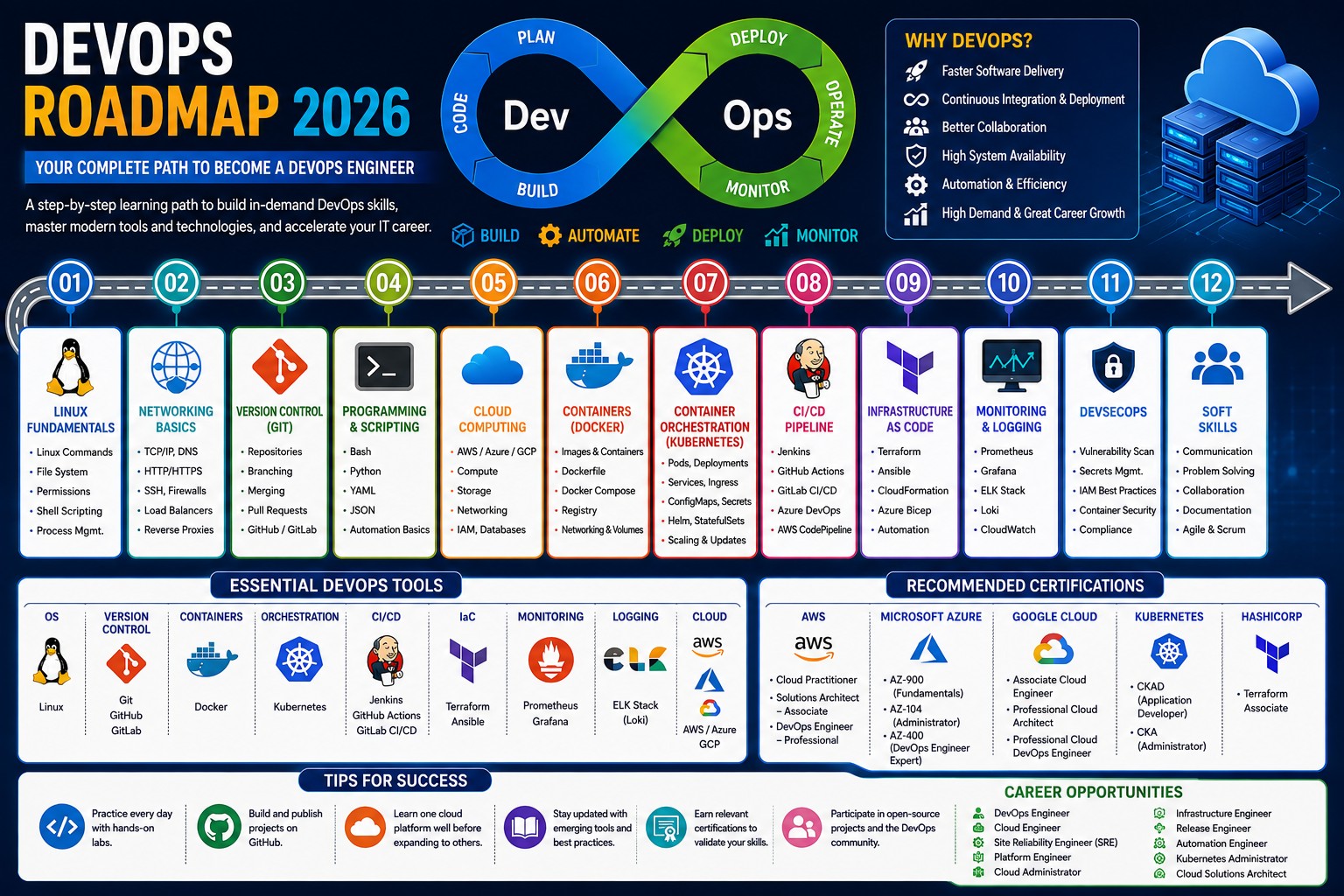
DevOps Roadmap 2026

Step 1: Learn Linux Fundamentals

  • Linux is the foundation of most cloud and DevOps environments.

Topic to Learn

  • Linux commands, File system management, User and permission management, Shell scripting, Process management, Package management, Networking basics

Step 2: Learn Networking Basics

  • A DevOps Engineer must understand networking concepts.

Topics

  • TCP/IP, DNS, HTTP & HTTPS, SSH, Firewalls, VPN, Load Balancers, Reverse Proxies

Step 3: Learn Version Control (Git)

  • Git is the industry standard for source code management.

Learn

  • Git installation, Repository management, Branching, Merging, Pull Requests, GitHub, GitLab, Bitbucket

Step 4: Programming & Scripting

  • Automation is a key responsibility in DevOps.

Languages

  • Bash, Python, PowerShell, YAML, JSON

Step 5: Learn Cloud Computing

  • Cloud knowledge is essential for modern DevOps roles.

Recommended Platforms

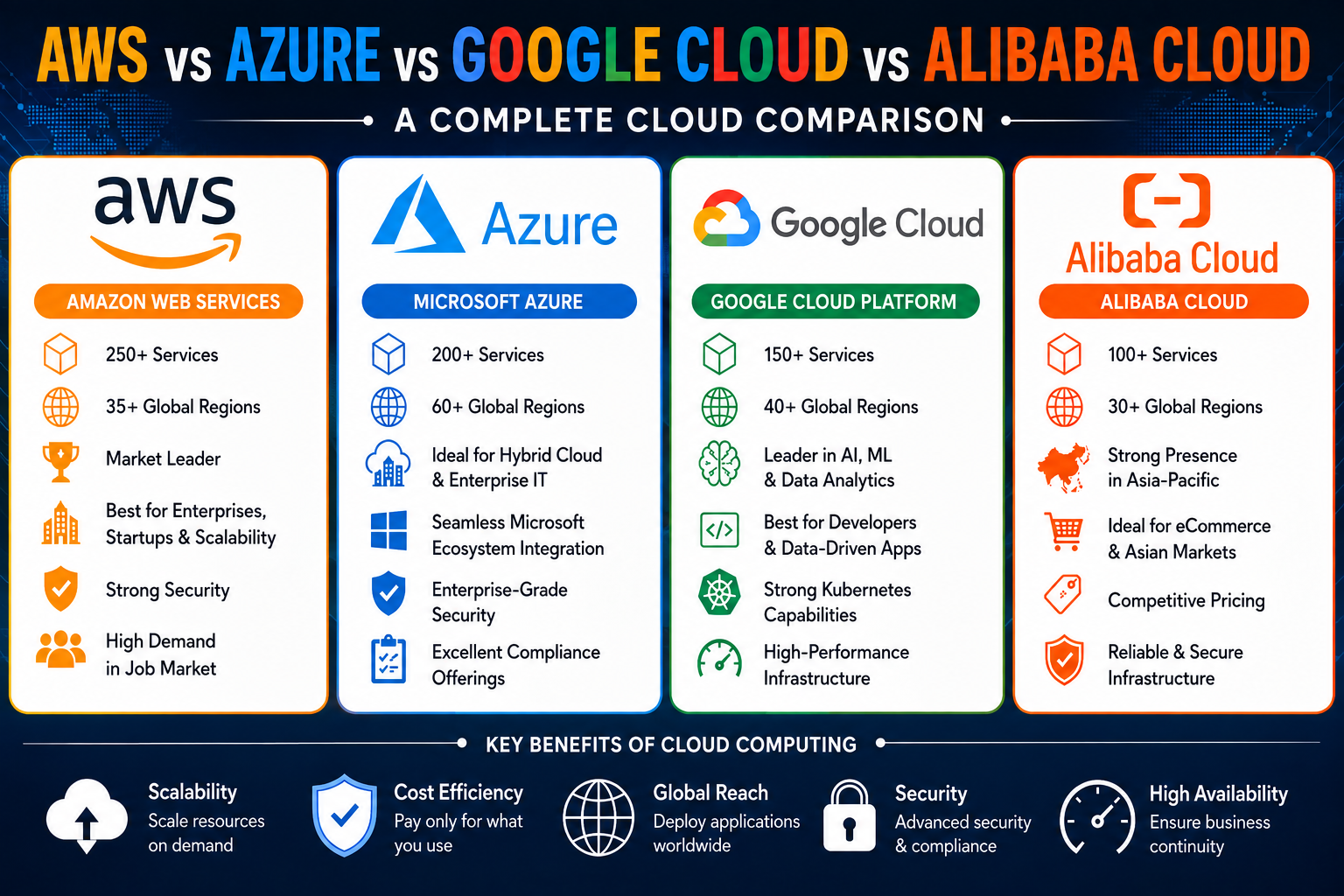
  • Amazon Web Services (AWS), Microsoft Azure, Google Cloud Platform (GCP)

Core Services

  • Compute, Storage, Networking, Databases, IAM, Monitoring

Step 6: Containers (Docker)

  • Docker enables consistent application deployment across environments.

Learn

  • Docker Images, Docker Containers, Dockerfile, Docker Compose, Docker Registry, Docker Networking, Docker Volumes

Step 7: Container Orchestration (Kubernetes)

  • Kubernetes is the leading platform for managing containerized applications.

Topics

  • Pods, Deployments, ReplicaSets, Services, Ingress, ConfigMaps, Secrets, Helm, StatefulSets

Step 8: Continuous Integration & Continuous Deployment (CI/CD)

  • CI/CD automates the software delivery process.

Popular Tools

  • Jenkins, GitHub Actions, GitLab CI/CD, Azure DevOps, AWS CodePipeline

Step 9: Infrastructure as Code (IaC)

  • Manage infrastructure using code instead of manual configuration.

Learn

  • Terraform, AWS CloudFormation, Azure Bicep, Ansible

Step 10: Monitoring & Logging

  • Monitoring ensures applications remain healthy and available.

Tools

  • Prometheus, Grafana, ELK Stack, Loki, Splunk, Datadog, CloudWatch, Azure Monitor

Step 11: DevSecOps

  • Security is now integrated throughout the DevOps lifecycle.

Topics

  • Vulnerability Scanning, Secrets Management, IAM Best Practices, Container Security, Dependency Scanning, Compliance, SAST & DAST

Step 12: Soft Skills

  • Technical expertise should be complemented by strong interpersonal skills.

Important Skills

  • Communication, Problem Solving, Documentation, Collaboration, Agile & Scrum, Time Management

Essential DevOps Tools in 2026

Category Popular Tools
Operating System Linux
Version Control Git, GitHub, GitLab
Programming Bash, Python
Containers Docker
Container Orchestration Kubernetes
CI/CD Jenkins, GitHub Actions, GitLab CI/CD
Infrastructure as Code Terraform, Ansible
Monitoring Prometheus, Grafana
Logging ELK Stack, Loki
Cloud AWS, Azure, Google Cloud

Recommended Certifications

AWS Microsoft Azure Kubernetes HashiCorp
  • AWS Certified Cloud Practitioner
  • AWS Certified Solutions Architect – Associate
  • AWS Certified DevOps Engineer – Professional
  • Azure Fundamentals (AZ-900)
  • Azure Administrator (AZ-104)
  • Azure DevOps Engineer Expert (AZ-400)
  • Certified Kubernetes Application Developer (CKAD)
  • Certified Kubernetes Administrator (CKA)
  • Terraform Associate

Hands-on Projects to Build Your Portfolio

Practical experience is one of the best ways to demonstrate your DevOps skills. Consider building projects such as:

  • Deploy a multi-tier web application on AWS
  • Build a CI/CD pipeline with Jenkins and GitHub
  • Containerize an application using Docker
  • Deploy microservices on Kubernetes
  • Provision cloud infrastructure using Terraform
  • Implement monitoring with Prometheus and Grafana
  • Configure centralized logging using the ELK Stack
  • Automate server configuration using Ansible

Career Opportunities

After following this roadmap, you can pursue roles including:

  • DevOps Engineer
  • Cloud Engineer
  • Site Reliability Engineer (SRE)
  • Platform Engineer
  • Cloud Administrator
  • Infrastructure Engineer
  • Release Engineer
  • Automation Engineer
  • Kubernetes Administrator
  • Cloud Solutions Architect

Tips for Success

  • Practice every day with hands-on labs.
  • Build and publish projects on GitHub.
  • Learn one cloud platform well before expanding to others.
  • Stay updated with emerging DevOps tools and best practices.
  • Earn relevant certifications to validate your skills.
  • Participate in open-source projects and the DevOps community.

Conclusion

DevOps is more than a collection of tools—it is a culture focused on collaboration, automation, and continuous improvement. By following this roadmap, gaining practical experience, and working on real-world projects, you can build the skills needed to succeed as a DevOps Engineer in 2026.

Whether you are a beginner or an experienced IT professional looking to transition into DevOps, a structured learning path will help you achieve your career goals.

Learn DevOps with IT Campus

At IT Campus, we offer hands-on, industry-focused DevOps training designed to prepare you for real-world projects and globally recognized certifications.

Our DevOps Training Includes

  • Linux Administration
  • Git & GitHub
  • Docker & Kubernetes
  • Jenkins CI/CD
  • Terraform & Infrastructure as Code
  • AWS DevOps
  • Microsoft Azure DevOps
  • Monitoring & Logging
  • Real-World Projects
  • Interview Preparation
  • Certification Guidance

Our expert instructors, practical labs, and project-based learning approach help you build job-ready DevOps skills with confidence.

Start your DevOps journey with IT Campus and build the skills needed for a successful career in cloud computing and automation.
About the author

IT Campus

IT Campus

A modern IT training institute delivering industry-focused courses, practical projects, and expert mentorship to equip learners with real-world skills for successful IT careers.

WhatsApp