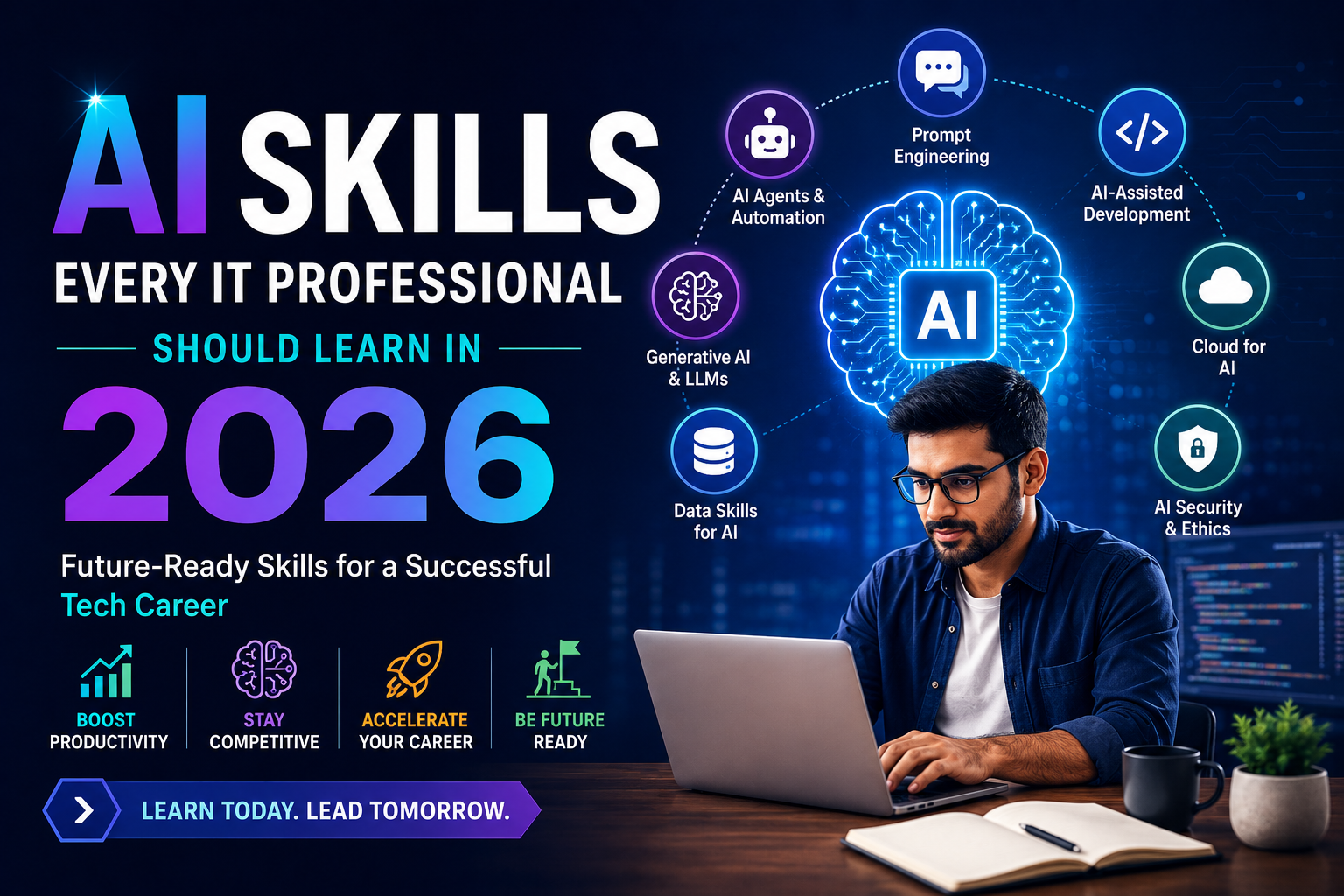
Artificial Intelligence is no longer a technology reserved for data scientists and AI researchers. In 2026, AI is becoming part of everyday work across software development, cloud computing, cybersecurity, DevOps, data analytics, IT support, project management, and business operations.
For IT professionals, the question is no longer whether AI will affect their careers. The more important question is:
How can you use AI to become more productive, solve better problems, and remain competitive in the technology job market?
The World Economic Forum identifies AI and big data, networks and cybersecurity, and technological literacy among the fastest-growing skill areas through 2030. The International Labour Organization also reports that AI adoption is increasing demand for AI literacy, digital skills, data skills, adaptability, and higher-order cognitive abilities.
At the same time, Coursera's 2026 Job Skills Report reports a 234% year-over-year increase in Generative AI enrollments among enterprise learners, highlighting how quickly organizations are investing in AI-related skills.
For IT professionals, this means developing practical AI skills is becoming an important part of staying career-ready.
AI is changing how technical teams work.
Developers can use AI coding assistants to accelerate development. Cloud engineers can automate infrastructure tasks. Cybersecurity teams can analyze large volumes of security data. Data professionals can use AI to explore and interpret information. IT support teams can automate repetitive requests.
However, simply knowing how to use ChatGPT or another AI tool isn't enough.
The most valuable professionals will understand how AI works, how to apply it to real business problems, how to verify its output, and how to use it responsibly.
This is why IT professionals should build a combination of literacy, prompt engineering, automation, data, programming, AI application development, security, and human problem-solving skills.
The first AI skill every IT professional should develop is AI literacy.
You don't need to become a machine learning researcher, but you should understand the basic concepts behind modern AI systems.
Learn About:
Understanding these concepts helps IT professionals make better decisions when selecting and implementing AI solutions.
For example, a software engineer should understand when to use an LLM API versus traditional application logic. A project manager should understand what AI can realistically automate. A cybersecurity professional should understand both AI-powered attacks and AI-powered defenses.
AI literacy is becoming a foundational technology skill—not just a specialization.
Generative AI is one of the most important AI skills to learn in 2026.
Tools based on large language models can generate text, code, documentation, summaries, test cases, ideas, reports, and other content.
But professional use requires more than simply entering questions into an AI chatbot.
IT professionals should learn how to incorporate Generative AI into real workflows.
Important Generative AI Skills Include:
The goal should be to move from:
"I know how to use an AI chatbot."
to:
"I know how to integrate AI into a professional workflow or application."
Prompt engineering remains a useful practical skill for working effectively with Generative AI.
A good prompt provides the AI system with the right context, instructions, constraints, and expected output.
Learn How To:
For example, instead of asking:
"Write a SQL query."
a better professional prompt might specify the database type, table structure, required output, constraints, and edge cases.
Prompt engineering is particularly useful for developers, business analysts, project managers, marketers, IT support professionals, and cybersecurity teams.
One of the most important emerging AI skills for IT professionals in 2026 is understanding AI agents.
Traditional AI applications often respond to individual requests.
AI agents are designed to perform more complex tasks by combining models with tools, data, workflows, and sometimes multiple specialized agents.
Recent industry analysis highlights a growing focus on better AI agents and interconnected autonomous workflows rather than simply increasing model size.
Learn:
For IT professionals, agentic AI could become particularly useful for automating repetitive technical and business processes.
If you want to build practical AI solutions, Python is one of the most useful programming languages to learn.
Python is widely used across:
Python Skills to Develop:
You don't need to become an advanced Python developer immediately.
Start by learning enough Python to automate tasks and connect applications with AI services.
The next step after learning Generative AI is understanding how to integrate AI into software.
Many organizations will not build their own foundation models. Instead, developers will integrate existing AI models into applications using APIs.
Learn
For software developers, this creates opportunities to build applications such as:
One of the most valuable technical concepts for AI application development is Retrieval-Augmented Generation, commonly known as RAG.
RAG allows an AI application to retrieve relevant information from external sources before generating a response.
This is particularly useful when organizations want AI systems to work with their own:
RAG Skills to Learn:
RAG is an important bridge between AI models and enterprise data.
AI is only as useful as the data supporting it.
Therefore, data skills are becoming increasingly important for IT professionals working with AI.
The World Economic Forum ranks AI and big data as the fastest-growing skill category in its Future of Jobs research.
Important Data Skills Include:
IEEE's 2026 technology survey also identifies data analysis, machine learning, data modeling, and AI ethical practices among key skills for AI-related hiring.
This means IT professionals should not focus only on AI models. They should also understand the data lifecycle behind AI applications.
AI is changing the software development workflow.
Developers can now use AI tools for:
However, developers still need strong programming fundamentals.
AI-generated code can contain errors, security vulnerabilities, performance problems, or incorrect assumptions.
Therefore, the valuable skill is not simply AI-generated coding. It is
AI-assisted software engineering + human code review + testing + architecture.
This combination can make developers significantly more productive while maintaining software quality.
Cybersecurity professionals should learn both sides of AI:
>Using AI for security and securing AI systems.
The World Economic Forum's Global Cybersecurity Outlook 2026 reports that AI is reshaping cybersecurity across both offense and defense. It also notes that lack of knowledge and skills is one of the major barriers to deploying AI for cybersecurity.
AI cybersecurity skills include:
Cybersecurity professionals who understand AI can become valuable contributors to modern security teams.
As organizations deploy AI more widely, they need professionals who understand the risks associated with AI.
AI systems can introduce issues involving:
IEEE's 2026 survey found AI ethical practices to be the top listed skill among AI-related hiring priorities in its survey.
Learn About:
Responsible AI knowledge will become increasingly important as businesses move from AI experimentation toward production systems.
AI workloads require significant computing, storage, networking, and data infrastructure.
This makes cloud computing an important supporting skill for AI professionals.
Major cloud platforms provide services for:
Learn:
Understanding AI + Cloud can open career paths in AI engineering, cloud engineering, DevOps, MLOps, and platform engineering.
Building an AI prototype is only one part of the process.
Organizations need to deploy, monitor, maintain, secure, and continuously improve AI systems.
This is where MLOps and AI engineering become important.
Learn:
If you already have DevOps experience, learning MLOps can be a natural next step.
One of the biggest benefits of AI is its ability to automate repetitive knowledge work.
IT professionals can combine AI with automation tools to create intelligent workflows.
For example.
AI + Python + APIs + Cloud + Automation
can be used to build systems that automatically analyze information, generate reports, classify requests, summarize incidents, or trigger business workflows.
Automation Skills to Learn::
The combination of AI and automation is particularly valuable because it turns AI capabilities into repeatable business processes.
Perhaps the most overlooked AI skill is the ability to think critically about AI output.
AI can produce impressive answers, but it can also produce incorrect information.
IT professionals need to know how to:
The World Economic Forum also identifies analytical thinking, creative thinking, resilience, flexibility, and lifelong learning as important skills alongside technology capabilities.
In other words:
AI may generate the answer, but professionals still need to determine whether the answer is useful and correct.
If you're unsure where to start, follow this practical roadmap.
Beginner Level
Start with:
AI Fundamentals → Generative AI → Prompt Engineering → AI Productivity Tools
Then learn:
Python → APIs → Data Fundamentals
Intermediate Level
Move into:
LLMs → RAG → Vector Databases → AI Automation → AI APIs
Then add:
Cloud → Docker → Git → CI/CD
Advanced Level
Develop:
AI Agents → MLOps → AI Security → AI Governance → Production AI Systems
This progression allows you to build skills gradually instead of trying to learn everything at once.
You don't necessarily need to abandon your existing IT career and become an AI engineer.
A better strategy may be to combine AI with what you already know.
For example:
Developer + AI = AI Application Developer
Cloud Engineer + AI = AI Cloud Engineer
DevOps + AI = MLOps / AI Platform Engineer
Cybersecurity + AI = AI Security Professional
Data Analyst + AI = AI Data Professional
Project Manager + AI = AI Transformation / AI Project Manager
This combination of domain expertise and AI capability can make your existing experience more valuable.
Follow these five steps:
1. Learn AI Fundamentals
Understand AI, machine learning, Generative AI, LLMs, and AI agents.
2. Learn to Use AI Professionally
Use AI for research, documentation, coding, analysis, automation, and productivity.
3. Build Technical Skills
Learn Python, APIs, SQL, cloud platforms, data, and automation.
4. Build Real AI Projects
Don't rely only on courses and certificates. Build projects such as:
5. Combine AI With Your Career
Apply AI to your existing specialization. This is where your skills become truly valuable.
AI is transforming the IT industry, but the future isn't simply about replacing IT professionals with AI.
It is about IT professionals who know how to work effectively with AI.
The most valuable professionals in 2026 will combine technical expertise with AI literacy, data skills, automation, security awareness, critical thinking, and continuous learning.
The World Economic Forum expects AI and big data, networks and cybersecurity, and technological literacy to remain among the fastest-growing skill areas, while the ILO highlights AI literacy, digital skills, adaptability, and human capabilities as increasingly important in the evolving workplace.
That is the approach that can help you build a future-ready technology career in 2026 and beyond.
At IT Campus, the goal is to help students and IT professionals develop practical, industry-relevant technology skills.
Whether you're interested in AI, cloud computing, DevOps, software development, cybersecurity, or other emerging technologies, building a structured learning path can help you turn knowledge into practical career skills.
Start learning today and prepare for the AI-powered future of IT.
A modern IT training institute delivering industry-focused courses, practical projects, and expert mentorship to equip learners with real-world skills for successful IT careers.
A modern IT training institute delivering industry-focused courses, practical projects, and expert mentorship to equip learners with real-world skills for successful IT careers.